
Unitree G1: full technical specifications, real capabilities and limits
Published on 12 October 2026 · By Salomon Cordebar
The Unitree G1 is a bipedal humanoid robot standing about 1.32 m tall and weighing 35 kg. Depending on its configuration, it has 23 to 43 degrees of freedom, a 3D LiDAR, a depth camera and a removable 9,000 mAh battery rated for about 2 hours of battery life. These figures describe its mechanical potential, but they do not on their own describe how it behaves in real conditions: at an event, the space available, the density of the crowd, the programmed movements and supervision by operators determine what it makes sense to have it do.
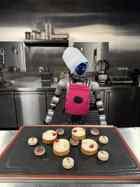
Unitree G1: the main technical specifications
The G1 comes in several configurations. Specifications vary in particular between the standard G1 and the G1 EDU versions intended for development. The standard Unitree G1 has 23 degrees of freedom, while some EDU configurations go up to 43.
| Specification | Unitree G1 |
|---|---|
| Standing height | About 1,320 mm |
| Width | About 450 mm |
| Depth | About 200 mm |
| Weight with battery | About 35 kg |
| Degrees of freedom | 23 on the G1; up to 43 depending on EDU configuration |
| Degrees of freedom per leg | 6 |
| Degrees of freedom per arm | 5 |
| Maximum knee torque | Up to 90 N·m on the G1; up to 120 N·m depending on EDU configuration |
| Battery | 9,000 mAh lithium, removable |
| Manufacturer's battery life | About 2 hours |
| Perception | 3D LiDAR and depth camera |
| Onboard computing | High-performance 8-core CPU |
| Connectivity | Wi-Fi 6 and Bluetooth 5.2 |
| Audio | 4 microphones and a 5 W speaker |
Specifications may vary depending on the version and the options installed.
A degree of freedom is an independent movement that a joint can perform. The number gives an indication of how rich the robot's range of gestures is: walking, changes of posture, independent arm movements and, depending on the configuration, additional joints in the upper body or the hands.
Perception, battery life and power: what do the figures mean?
The G1 combines a 3D LiDAR and a depth camera. The LiDAR measures the distance of objects around the robot and produces a three-dimensional representation of its surroundings. The depth camera complements this perception. These sensors are an important technical foundation, but they do not mean that a humanoid can be dropped in the middle of a trade show and move around on its own all day.
Unitree quotes about 2 hours of battery life with a removable 9,000 mAh battery. This figure should be read as a manufacturer's indication: consumption depends heavily on the movements. A relatively static posture, occasional walking and a light sequence of gestures do not draw on the battery in the same way as a succession of dynamic movements.
At events, we therefore think in terms of entertainment sequences rather than continuous dynamic operation. This approach makes battery management easier and, above all, preserves the highlights: a humanoid draws more attention when it appears at chosen moments than when it stays active without a break.
Joint torque is the rotational force produced by the motors at the joints. Weighing about 35 kg and with joints capable of fast movements, the G1 can produce very dynamic gestures. The flip side of this capability is the need to keep a suitable movement area and not to treat the machine as a toy.
What the Unitree G1 can really do at an event
For an event, the G1's value lies mainly in its physical presence and its ability to produce movements that are immediately recognisable as humanoid. It can walk around a defined area, perform prepared choreographies, adopt different postures, pose with visitors, accompany a stage entrance or create a focal point in front of a stand.
- Walkabouts within a defined, suitable area.
- Prepared choreographies and gesture sequences.
- Photos and videos with visitors.
- Stage entrances, product launches or grand openings.
- One-off entertainment on a stand or at a corporate party.
- Carrying light props when the configuration and the sequence allow it.
In this context, the robot becomes a tool for event scripting. Two services using the same G1 can produce very different results: the choice of movements, their timing, the robot's position, the space available and the operators' work matter as much as the spec sheet. This is the approach we take in our humanoid robot services.
Having operators present remains essential in the middle of a crowd. It makes it possible to adapt the robot's movements to the density of visitors, to handle unexpected interactions and to interrupt a sequence if the surroundings are no longer suitable. The aim is not to demonstrate maximum theoretical autonomy, but to deliver controlled entertainment under the real conditions of the event.
What the Unitree G1 does not do
Demonstration videos of humanoids can give the impression that a robot like the G1 spontaneously understands its surroundings and can carry out any task. That is not the case. A G1 is not an autonomous artificial human able to arrive in an unfamiliar place, understand a complex task on its own and improvise all its interactions among hundreds of people.
Some demonstrations rely on specially developed movements, controlled environments, dedicated algorithms or prepared sequences. The standard G1 must also be distinguished from the EDU versions, which meet different development needs.
For an event, the useful rule is simple: you do not build a service around what the robot could theoretically do, but around what it can perform in a controlled way at the venue, in front of the audience and for the planned duration.
Buying the robot can make sense for a company, a laboratory or a technical team that wants to develop robotic applications over the long term. For a one-off operation, the robot is only one part of the set-up: transport, preparation, batteries, operation, sequences and management of the surroundings must also be taken into account. Hire with operators spares the organiser from having to run the system themselves.
The spec sheet is therefore not enough to choose a humanoid. The decisive questions are often very practical: space available, crowd density, type of floor, walkabout or fixed area, indoors or outdoors, length of the sequences and the effect you are after. The G1 is a mobile, expressive humanoid platform; its value at an event comes above all from the way its capabilities are scripted in front of a real audience.
Frequently asked questions
How tall is the Unitree G1?
The Unitree G1 is about 1.32 metres tall, about 45 cm wide and 20 cm deep when standing.
How much does the Unitree G1 weigh?
The manufacturer quotes a weight of about 35 kg with its battery, with possible variations depending on the configuration.
What is the Unitree G1's battery life?
Unitree quotes about 2 hours of battery life with a 9,000 mAh battery. Actual battery life depends heavily on the movements and how intensively the robot is used.
How many degrees of freedom does the G1 have?
The standard G1 has 23 degrees of freedom. Some G1 EDU configurations go up to 43 degrees of freedom, depending on the options.
Can the Unitree G1 work on its own during an event?
Its sensors and computing power allow advanced functions, but a service in the middle of a crowd should not be equated with full autonomy. Supervised operation keeps movements, sequences and interactions under control.
Can a Unitree G1 be hired (rented) for a trade show or an event?
Yes. Libella Robotics offers event services with a humanoid robot for trade shows, product launches, grand openings and corporate events.
Author
Salomon Cordebar
CEO and co-founder of Libella Robotics
Co-founder of Libella Robotics, he operates the company's Unitree G1 humanoid robot hire services at professional events in France.
LinkedIn profile