
Unitree G1, Pepper, NAO or robot dog: which robot for your event?
Published on 12 October 2026 · By Salomon Cordebar
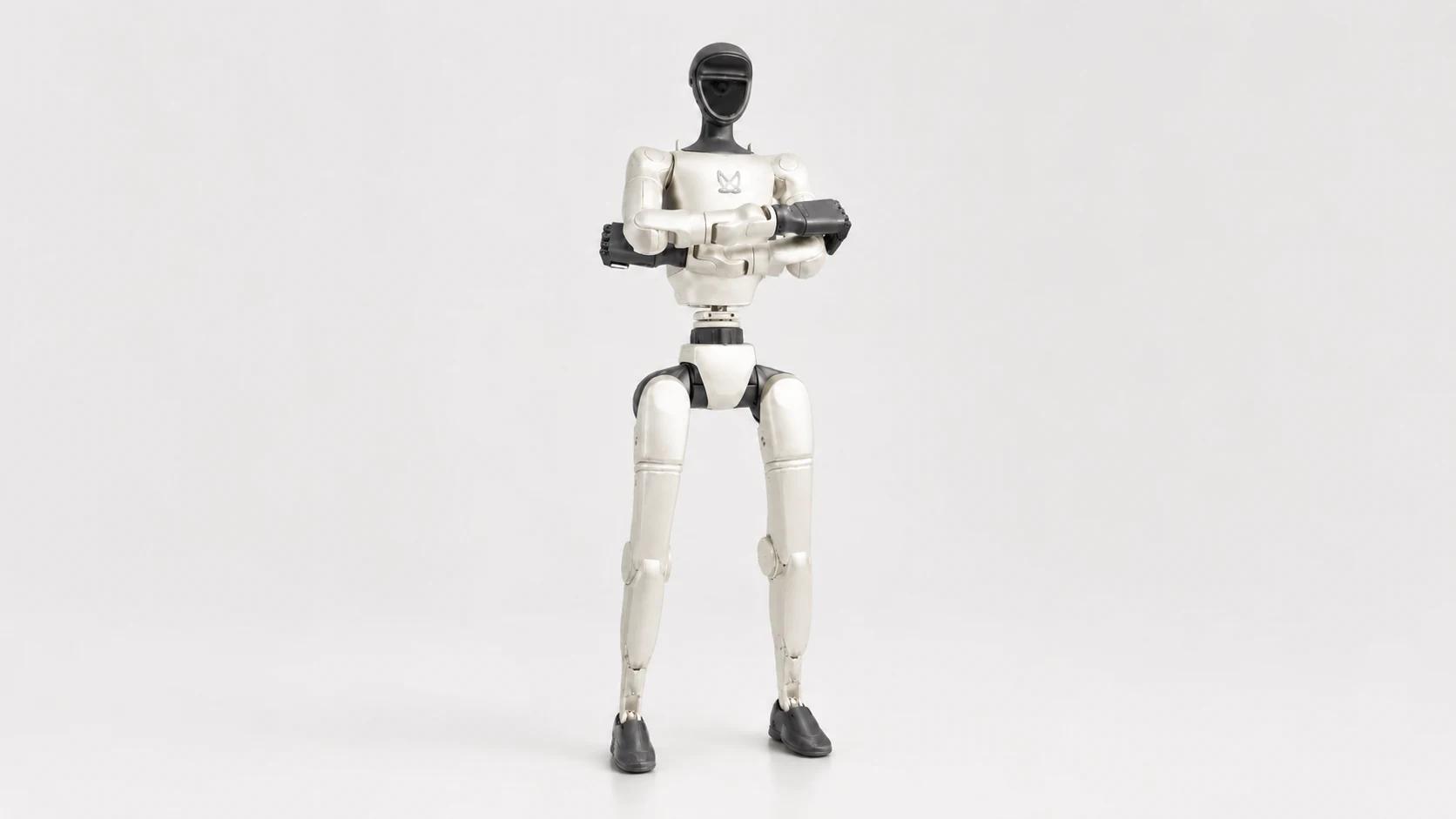
For a professional event in France, the choice comes down to four robot families. The quadruped robot dog (€200 to €500 excl. VAT per day) creates curiosity. The screen-based service robot (€250 to €950 excl. VAT per day) performs a specific task but does not draw a crowd. The wheeled humanoid such as Pepper (€950 to €2,500 excl. VAT per day) talks and displays content, but does not walk. The recent bipedal humanoid such as the Unitree G1 (from €1,500 excl. VAT per half day, operator included) walks among visitors: it is the only family that spontaneously gathers a crowd and generates videos. The deciding criterion is not the spec sheet, it is the effect you are after.
The comparison, family by family
The word “robot” covers machines that have almost nothing in common, whether in capabilities, price or their effect on an audience. Here are the four families actually offered for event hire in France, with the public price ranges recorded on the French market in July 2026.
| Family | Example | How it moves | Observed price | What it produces |
|---|---|---|---|---|
| Quadruped robot dog | Unitree Go2 | Four legs, stairs, uneven ground | ≈ €200 – €500 excl. VAT / day | Curiosity, photos |
| Screen-based service robot | Tray robots, reception robots | Wheels, flat floor | ≈ €250 – €950 excl. VAT / day | A service: handing out, guiding, displaying |
| Wheeled humanoid | Pepper | Wheeled base, no functional legs | ≈ €950 – €2,500 excl. VAT / day | Speech and a touchscreen |
| Recent bipedal humanoid | Unitree G1 | Real walking, up to 2 m/s | from €1,500 excl. VAT / half day | A crowd and spontaneous videos |
Ranges recorded from offers published by French hire companies in July 2026. Most providers only communicate their prices on quotation. The Unitree G1 rate is our own, operator and set-up included.
A useful way to read this table: the first three families do something, the fourth produces an effect. A service robot hands out flyers better than a humanoid; a bipedal humanoid hands out nothing but stops people in an aisle. These are two different jobs, not two price ranges.
Why “humanoid robot” means nothing in a quote
This is the most common trap on the market, and it is not always deliberate. The term humanoid robot covers a tablet mounted on a wheeled base just as well as a machine that walks, regains its balance after a push and climbs steps. The price gap is one to five. The gap in effect on an audience is greater still.
The difference comes down to one thing: walking. A bipedal robot is never in passive balance: it falls as soon as its motors stop correcting its posture, several hundred times per second. That is what made these machines hard to produce for twenty years, and it is what the public perceives immediately, without being able to name it.
The practical consequence: insist on the manufacturer and the model reference, in writing, in the quote. It is the only piece of information that commits the provider. “Latest-generation humanoid robot” commits no one.
Choose according to the effect you want
Start from what you want to happen, not from what the machine can do. Four situations cover the vast majority of requests.
- You want traffic to your stand in a hall with several hundred exhibitors: you need to be visible from the aisle, above people's heads. Only an adult-sized humanoid that moves around meets that condition. A tabletop device can only be seen from three metres away.
- You want the public to make videos: you need a scene unusual enough for taking out a phone to feel justified. It is a threshold, and most entertainment does not reach it. A biped walking towards someone crosses it.
- You want to provide a service (handing out items, guiding, keeping people occupied while they wait): a service robot does this better and for less. Do not pay for a humanoid to carry a tray.
- You want curiosity on a contained budget, on difficult ground or outdoors: the robot dog is the answer. It gets over what a biped cannot, and it costs three to five times less.
If your need is first and foremost to display messages or offers to passing footfall, none of these four families is optimal: that is the territory of the media robot, a mobile screen-based medium that goes to meet the public rather than waiting for it.
What the table does not tell you
Three constraints appear on no spec sheet and yet decide whether a service succeeds.
- The floor. A biped walks on a flat, smooth, clear floor: fitted carpet, parquet, polished concrete, marble. Not gravel, sand, grating or very uneven boards. This is validated in advance, from photos if necessary, never on the day.
- The operator. A bipedal humanoid is controlled by a trained operator throughout the service. This is not an option: it is what ensures public safety and the quality of interactions. A provider who bills it as an extra is advertising a headline price that corresponds to no real service.
- Battery life. It is counted in hours and melts away with continuous walking. The right question is not “what is the battery life?” but “how much actual presence time for the robot, and with how many batteries?”.
A fourth, more insidious constraint: continuous presence. A device that is visible without interruption for eight hours stops being noticed after half an hour; visitors who arrive later perceive it as furniture. Timed appearances produce the opposite effect, and the wait itself becomes a signal.
Five questions to ask before you sign
- Who is the manufacturer and what is the exact model reference? If the answer stays vague, so is the rest of the quote.
- Is the operator included in the advertised price, or billed as an extra?
- How much actual presence time for the robot, rather than what span of hours?
- Is travel included, charged at a flat rate or billed at cost? It is the item that most often makes an invoice drift, especially when the equipment comes from abroad.
- Can I see a real video of this specific model, filmed by you and not by the manufacturer?
That last question is the most discriminating, and also the easiest to ask. A manufacturer's video shows a machine in laboratory conditions; a video shot by the provider shows what you will get. Here is ours, filmed in the streets of Paris, with no special effects:
To go further on budgets by type of event and the hidden costs of the market, our price survey of the French market details the ranges family by family and what a serious rate should cover: how much does it cost to hire a robot for an event.
Frequently asked questions
What is the difference between a wheeled humanoid and a bipedal humanoid?
The biped walks on two legs while actively managing its balance; the wheeled humanoid moves on a motorised base and has no functional legs. It is this walking that the public perceives, and it explains most of the gap in price and effect between the two families.
A robot dog costs less: is it a good compromise?
It is an excellent choice if you are after curiosity, a contained budget or difficult ground: it handles stairs and uneven floors where a biped cannot cope. It does not, however, produce the same effect: a robot dog surprises, whereas a human-shaped machine walking towards a visitor creates a moment of a different order, because the public compares itself to it.
Is Pepper still an option in 2026?
It is still offered for hire in France, at around €950 to €2,500 excl. VAT per day, and suits a talking reception role or a quiz on a stand. Two reservations: it does not walk, and its production has been suspended since 2021, so the fleet is ageing with no possible renewal. The main point to watch is that a quote announcing a “humanoid robot” without naming the model can mean Pepper just as well as a recent biped.
How much does it cost to hire a bipedal humanoid?
From €1,500 excl. VAT per half day with the “Présence” package (half-day presence package) at Libella Robotics, operator and set-up included. Full-day formats and bespoke scripted services are quoted on request, with a sliding-scale rate for the additional days of a multi-day event. Reply within 24 hours.
Can the robot be used outdoors?
A biped, only on a flat, smooth and dry surface: a terrace or a smooth forecourt is fine, gravel or sand is not. A quadruped robot dog is far more tolerant on this point; it is actually its main advantage.
Do all these robots need an operator?
For a bipedal humanoid, yes, without exception: control by a trained operator throughout the service ensures public safety and the quality of the experience. Service robots run autonomously on a defined route, with lighter supervision.
Author
Salomon Cordebar
CEO and co-founder of Libella Robotics
Co-founder of Libella Robotics, he operates the company's Unitree G1 humanoid robot hire services at professional events in France.
LinkedIn profile